

By Mark G. Dziak
Northeastern Pennsylvania’s Wyoming Valley is a 17-mile-long patchwork of small towns and cities tucked in a pocket between the northern Appalachians. These mountains split to admit the Susquehanna River, which runs almost directly down the middle of the valley. Along this course, it meets several feeder streams that bolster it for its long, twisting trip to the Atlantic Ocean.
The largest of these feeders, intersecting near the city of Pittston, is the Lackawanna River. If you ask locals about the spot where the Susquehanna and Lackawanna rivers meet, they may describe what the place is like today. It’s a busy hub for railroad freight cars, as it has been for generations. It’s been pitted and polluted by mining operations, but some spots are still good for a lazy afternoon of fishing or hiking. But other locals will tell you about times much longer ago. They’ll spin tales about the days when Native Americans camped along the riverbanks and canoed the waters—how they braved the wilds, hunting and exploring. These perspectives, while contrasting, are both true: drastically different peoples have lived near this river confluence for more than 10,000 years.
While few records remain of the ancient inhabitants of Wyoming Valley and the momentous transition that occurred when European settlers first arrived there, the stories aren’t necessarily lost. A small group of people are searching under the surface to learn more, and they are making some striking discoveries. Meet the volunteer archaeologists of the Frances Dorrance Chapter of the Society for Pennsylvania Archaeology. On any given Sunday, from when the soil thaws to when it freezes again, you’ll find Chapter members hard at work near the river confluence, searching for new insights into the place and its past. Some are troweling through the earth, often a millimeter at a time. Others are lugging buckets of soil to the screeners or climbing in and out of the excavation to bag and record artifacts, take measurements, or make detailed records on forms and grid paper. Every flake of stone and jotted note will be analyzed and catalogued during the wintertime, when the ground is frozen as hard as their trowels.
Just as impressive as their passion is their dedication: volunteers from the chapter have been studying the area for more than 30 years. During that time, they’ve recorded three significant archaeological sites. The Cremard Site and Conrail Site reach back to ancient times. The Phillips Site picks up the story around the 1700s, a tumultuous time that saw the departure of Native Americans and arrival of European settlers. Collectively, these sites make up the Conrail Archaeological Site Complex.
The Frances Dorrance Chapter’s long journey through time began with an accident.
This is an excerpt of ‘Where the Currents Meet,’ in American Archaeology, Winter 2025, Vol. 29, and No. 4. Subscribe to read the full text.
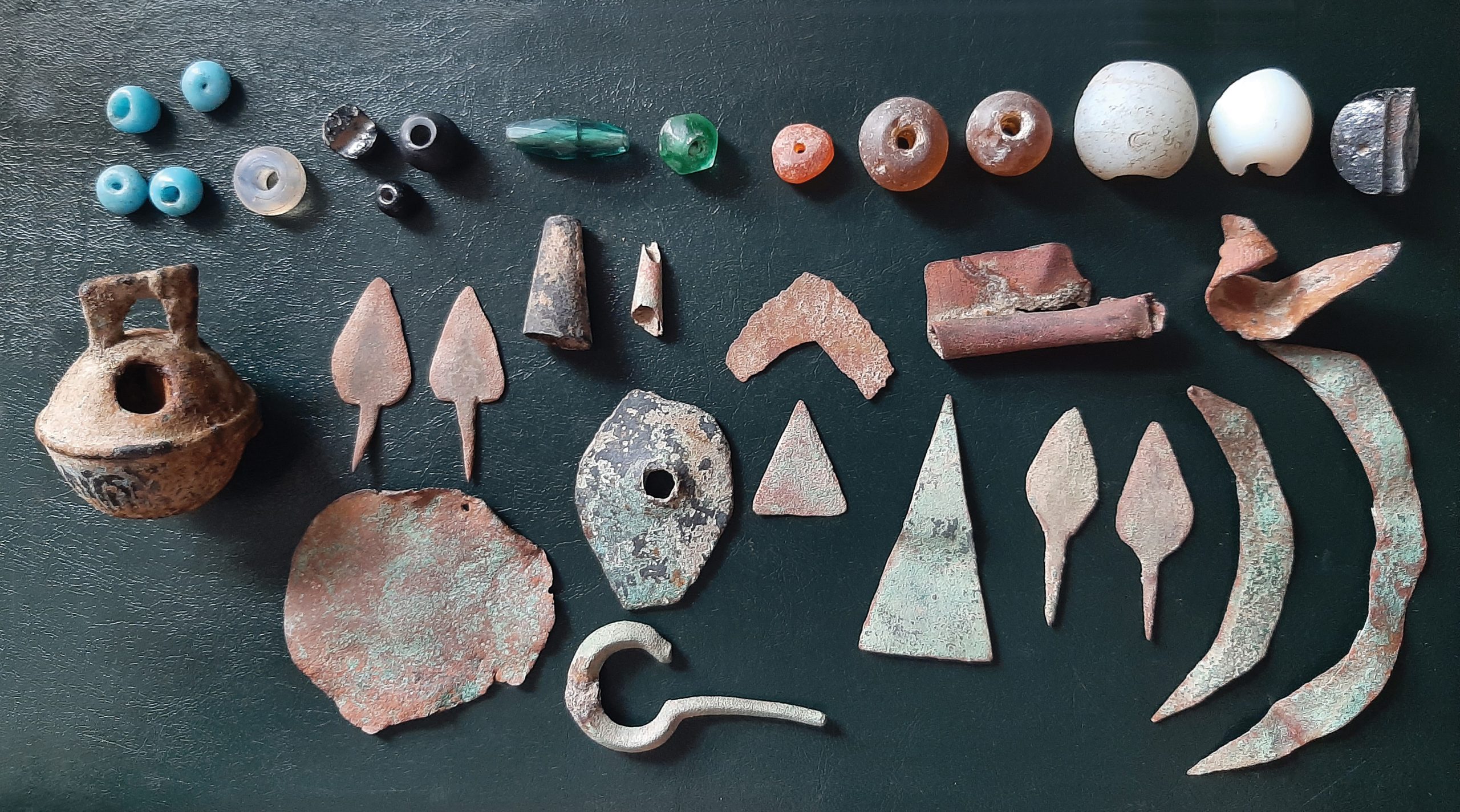
Glass beads, cut copper, a bell, and a jaw harp from the Phillips Site and nearby riverbank suggest intercultural trade in the 1700s. Photo courtesy of the Frances Dorrance Chapter.