
By Julian Smith
Between Baton Rouge and New Orleans, the roads along the Mississippi River wind among cypress groves and towering live oaks with moss-draped branches. Beyond grass-topped levees, massive barges and tankers sweep past where riverboats once hauled cargo a century and a half ago. Reminders of the region’s complex and painful past are everywhere along the route, from the white columns of old plantation houses to the green stalks of sugarcane fields. In the late 19th century, these same fields were home to more than 1,300 sugar plantations, their wealth built on the labor of thousands of enslaved people. Once the dominant feature of this landscape, the crop and its remaining industrial mills now share space with petrochemical plants, oil refineries, and grain terminals. “Sugar has always been a huge part of Louisiana’s history and economy and is still very much an integral part of the cultural landscape,” said Chip McGimsey, Louisiana State Archaeologist, who recently retired after 44 years in the position. But its deeper story is in danger of being erased by time and development.
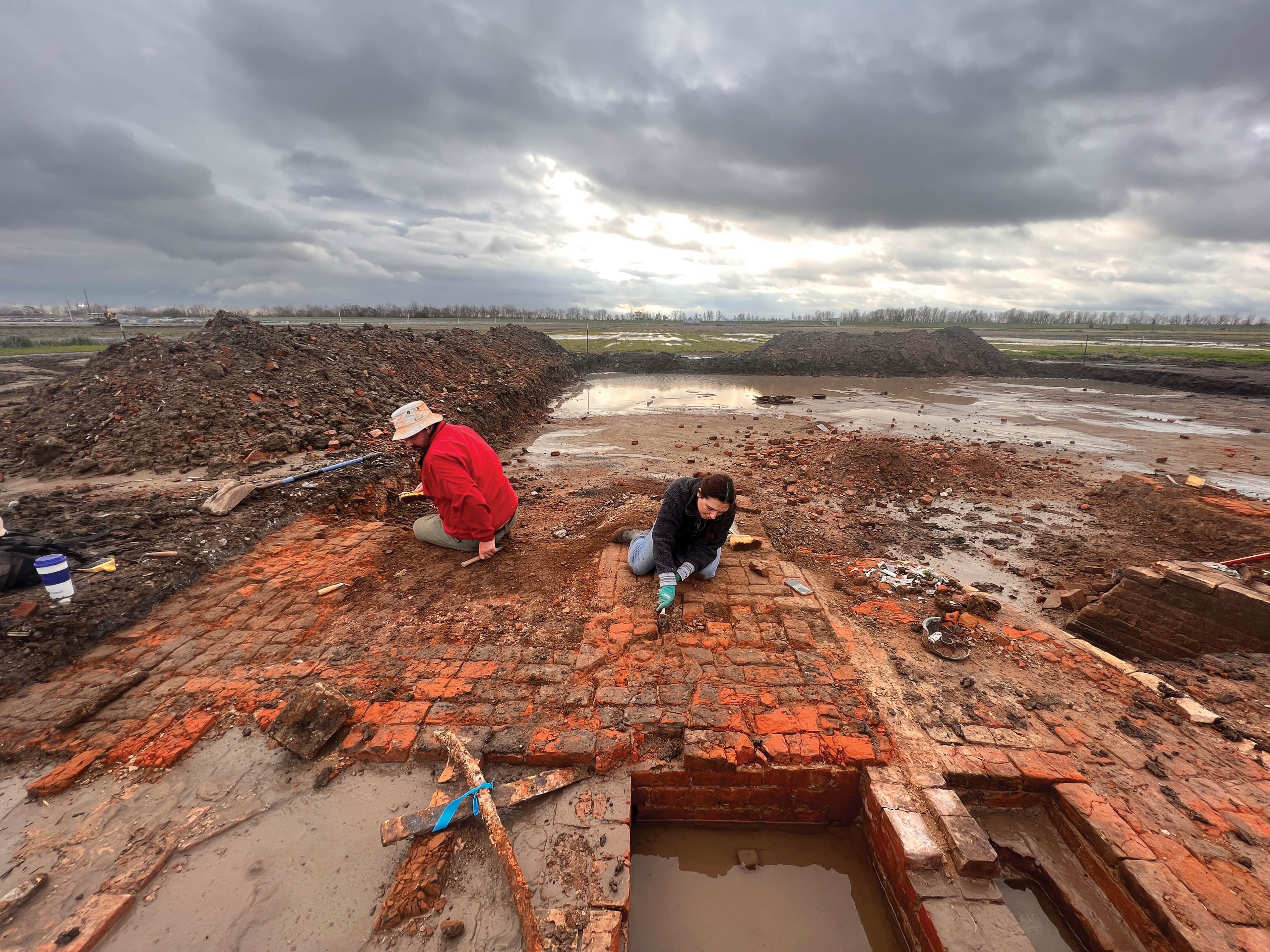
Archaeologists scrape bricks and clear rubble at the Upper Eimer Sugarhouse. Photo by Cat Strader
TerraXplorations, a cultural resource management (CRM) firm based in Tuscaloosa, Alabama, is working to change that through excavations, historical research, and creative public outreach efforts.
“It’s important that we as historians and archaeologists get our information out to the general public,” said TerraX owner Paul Jackson. “People always love archaeology, but we don’t always do a great job at getting them involved.”
TerraX conducts hundreds of projects every year, mostly in the Southeast, for clients in the public and private sectors. A large part of their work is helping clients comply with laws governing construction or development projects that might affect historical and cultural resources, including the National Historic Preservation Act and the Archaeological and Historic Preservation Act. More than 70 employees with expertise in everything from archaeology and historical research to lab analysis and public interpretation work together to preserve and record valuable cultural heritage.
The CRM process has three phases, starting with a search of existing records such as maps, diaries, newspapers, and business documents, as well as a visual field survey. If cultural resources are found, Phase II is a more detailed investigation to evaluate their significance, including whether a site is eligible for listing on the National Register of Historic Places.
A full Phase III archaeological excavation, or mitigation, happens if there are significant cultural resources that can’t be preserved in place and are likely to be impacted by development. This includes detailed documentation and analysis, with the goal of collecting as much information as possible before the resource is disturbed or destroyed.
In southern Louisiana, where many former sugar plantation sites are now owned by petroleum or chemical companies, this sometimes means researching and excavating the remains of sugar-making facilities, known as “sugarhouses,” before modern construction can proceed.
While tourists can choose from a wide range of ornate antebellum plantation houses to visit, few sugarhouse sites have been investigated in detail. The total is probably no more than 15 since the 2000s, said Joanne Ryan of the environmental consulting firm Coastal Environments, who has worked on many of them. “They’re essentially industrial sites, but they were the heartbeat of the entire plantation, the source of all income and the focus of all labor.”
This is an excerpt of ‘The Stones Are Speaking,’ in American Archaeology, Fall 2025, Vol. 29, and No. 3. Subscribe to read the full text.
FURTHER READING
- TerraXplorations, Inc., www.terraxplorations.com
- Dig Deeper, TerraXplorations blog
- Documenting Louisiana’s Sugar, a project by the University of Sussex