
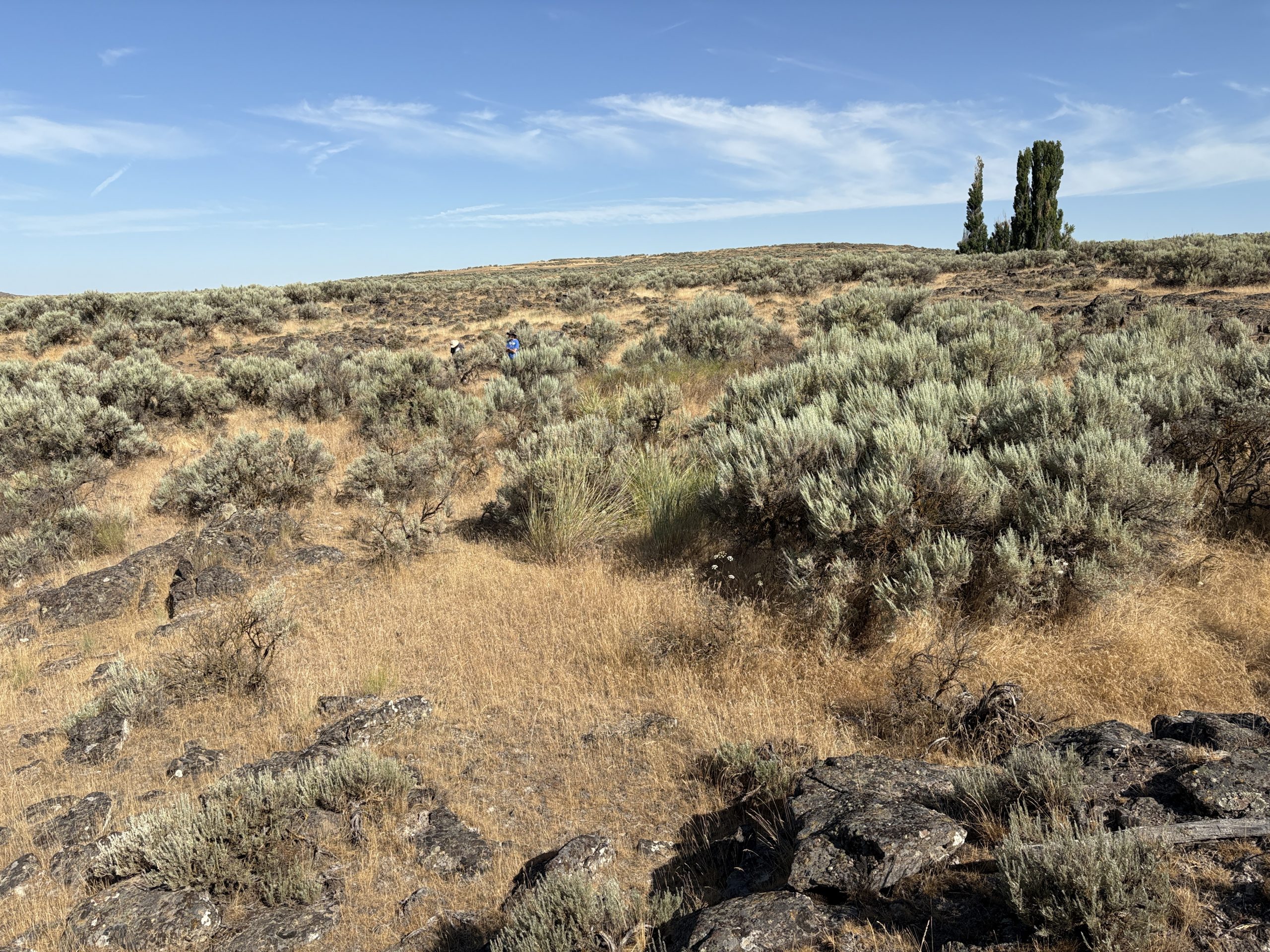
WEST—In early July, Western Regional Director Linsie Lafayette visited the Sylvan Lake Preserve in eastern Washington’s Lincoln County within the Channeled Scablands. The scablands were carved by cataclysmic Ice Age floods creating a dramatic landscape riddled with coulees, dry falls, and scoured basalt.
The preserve—a pre-contact pithouse village—is situated near a spring, overlooking Sylvan Lake, now surrounded by wheat fields. Pithouses appear archaeologically as circular depressions in the ground approximately 33 feet (10 meters) in diameter, and about 3 feet (1 meter) deep. This village is made up of nine of these features.
No excavations have been conducted at Sylvan Lake, but based on nearby studies, it is likely to date from 500 B.C. to A.D. 1800. Prior to that, people likely only passed through the uplands staying only for a short time, not long enough to expend the energy needed to build a pithouse.
On the Columbia Plateau, most archaeological research has focused on rivers, often in advance of dam construction. Early explorers and settlements also followed rivers, leaving upland areas like Sylvan Lake underrepresented in archaeological and ethnographic studies.
According to the Washington State Department of Archaeology and Historic Preservation (DAHP), the preserve sits on the ancestral lands of the Confederated Tribes of the Colville Reservation and the Spokane Tribe of Indians. The preserve was acquired by The Archaeological Conservancy in 1995.
Pictured: Sylvan Lake Preserve contains a pre-contact pithouse village. Photo by Linsie Lafayette / TAC.