
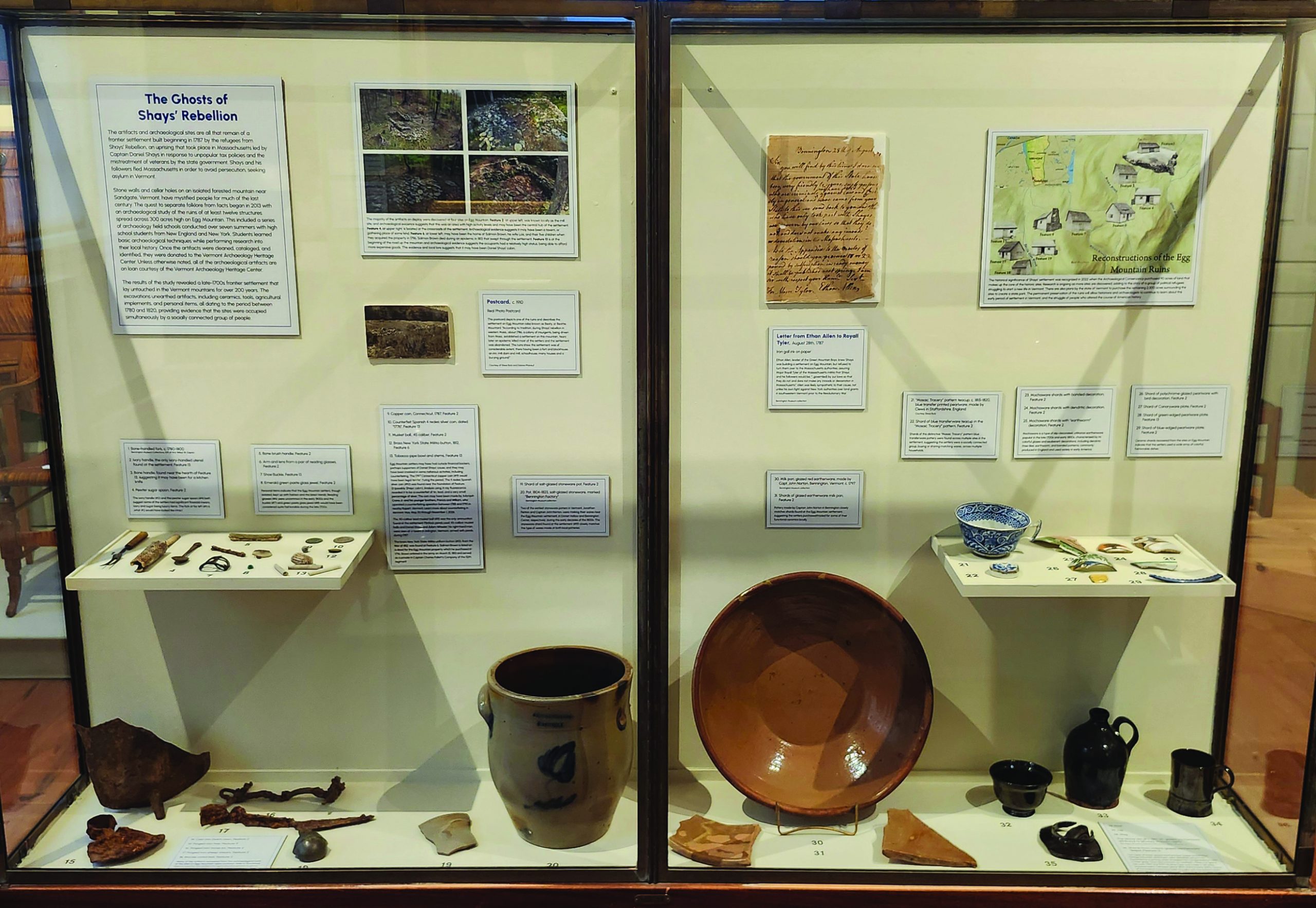
EAST—As of this spring, artifacts recovered from excavations at the Egg Mountain Settlement Preserve in Sandgate, Vermont, are on display at the Bennington Museum in southwestern Vermont. Archival research and fieldwork led by researcher Dr. Stephen Butz indicate that the site was occupied from the late 1700s to about 1820. Butz recently completed a dissertation related to his work there.
In addition to its importance for understanding early rural subsistence in the region, the site is thought to be the place where Daniel Shays and his followers fled after the failure of Shays’ Rebellion, the 1786–1787 uprising sparked by high taxes and a debt crisis in Massachusetts. Artifacts from the site are now curated by the State of Vermont, where they will remain accessible for future research.
The objects on display at the Bennington Museum are on loan and can be seen in the museum’s Early Vermont Gallery. They include ceramics, metal objects, other small finds, and a “lye stone” used in making soap.
The site became a Conservancy preserve in 2022, when it was acquired from The Conservation Fund with support from a grant from the Vermont Housing and Conservation Board. The parcel was part of a much larger acquisition by The Conservation Fund to protect a portion of the Cowee Forest. Efforts to protect and manage the remaining land, which contains additional deposits related to the Egg Mountain settlement, are ongoing.
Pictured: Midwest Regional Director Lindsay Scott stands with a volunteer near the newly installed snow fencing at the Sumnerville Mound site. Photo courtesy of Lindsay Scott.