
Last year, The Archaeological Conservancy received an inquiry from North Carolina author Hoke Kimball, who has been researching the homes of early colonial governors. Kimball hoped to learn more about the Conservancy’s Eden House Preserve, which is thought to be the site of a large manor house built for Charles Eden, North Carolina’s second governor. Eden served from 1715 to 1722, first spending time in Bath before having Eden House constructed in 1718 farther north along the Chowan River. The house was likely completed around 1720. After Eden’s death, his stepdaughter Penelope Golland—one of the wealthiest women in colonial North Carolina—continued to live there, including during her marriage to future governor Gabriel Johnston.
The 2.6-acre property was donated to the Conservancy in 2000 by William and Wanda Bell. Although local tradition and a limited surface collection had long suggested it was the site of the house, no formal survey had been conducted to confirm that. Interested in the house’s size and construction, Kimball proposed working with Richard Grubb & Associates, Inc. (RGA), a regional cultural resource management firm, to conduct a ground-penetrating radar survey. While the Conservancy does not typically undertake research projects with private individuals, the noninvasive nature of the survey meant it would not harm the site and could help staff better understand, manage, and protect its cultural resources.
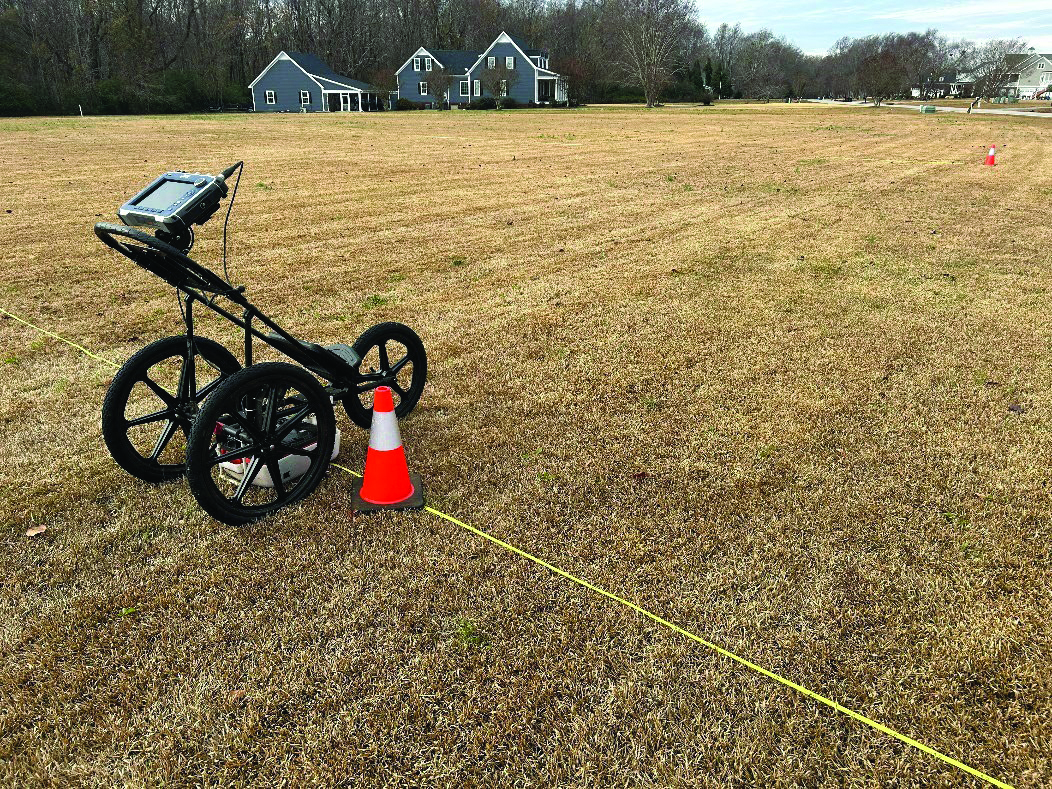
This past winter, an RGA team led by Jenifer E. Elam carried out archival research and completed the GPR survey, which was conducted by Donald Rowe. The survey identified 13 anomalies. One, measuring roughly 62 by 44 feet, appears to be a strong candidate for the manor house foundation. Several others may represent features related to the property’s 18th-century use, including compacted living surfaces associated with barns or other outbuildings.
The work has significantly improved the Conservancy’s understanding of both the manor house’s size and its likely location within the parcel while also laying important groundwork for any future investigation of the site. The Conservancy is grateful to Kimball and RGA for their patience and excellent work on the project.