
By Linsie Lafayette
In 1980, The Archaeological Conservancy began an ambitious effort to build a national system of archaeological preserves, protecting significant sites that might otherwise be lost to development, looting, erosion, or neglect. That first year, the newly formed organization preserved four sites in four states. More than four decades later, the acquisition of Se Nshong Duñ, an extensive Indigenous chert quarry in northern California, marks the Conservancy’s 600th site—and another important step in ensuring that irreplaceable places remain available to descendant communities and future generations of researchers.
The story of Se Nshong Duñ, or “Good Rock Place,” began roughly 150 million years ago at the bottom of the ocean. Microscopic organisms called radiolarians settled on the seafloor, where their silica-rich skeletons accumulated and, over time, formed layers of chert. The oceanic rocks and sediments were later carried toward the edge of the North American continent on a tectonic plate. As the plate descended beneath the continent, portions of this material were scraped off, faulted, folded, and eventually uplifted and exposed. These rocks became part of the Franciscan Complex, a varied assemblage of chert, sandstone, shale, basalt, and other materials exposed throughout California’s Coast Ranges.
For thousands of years, the chert within this formation provided an invaluable resource. Franciscan chert was fashioned into spear points—including late Pleistocene Clovis points—as well as arrow points, scrapers, and knives used to butcher animals and process plants. High-quality chert may also have been a valuable trade commodity.
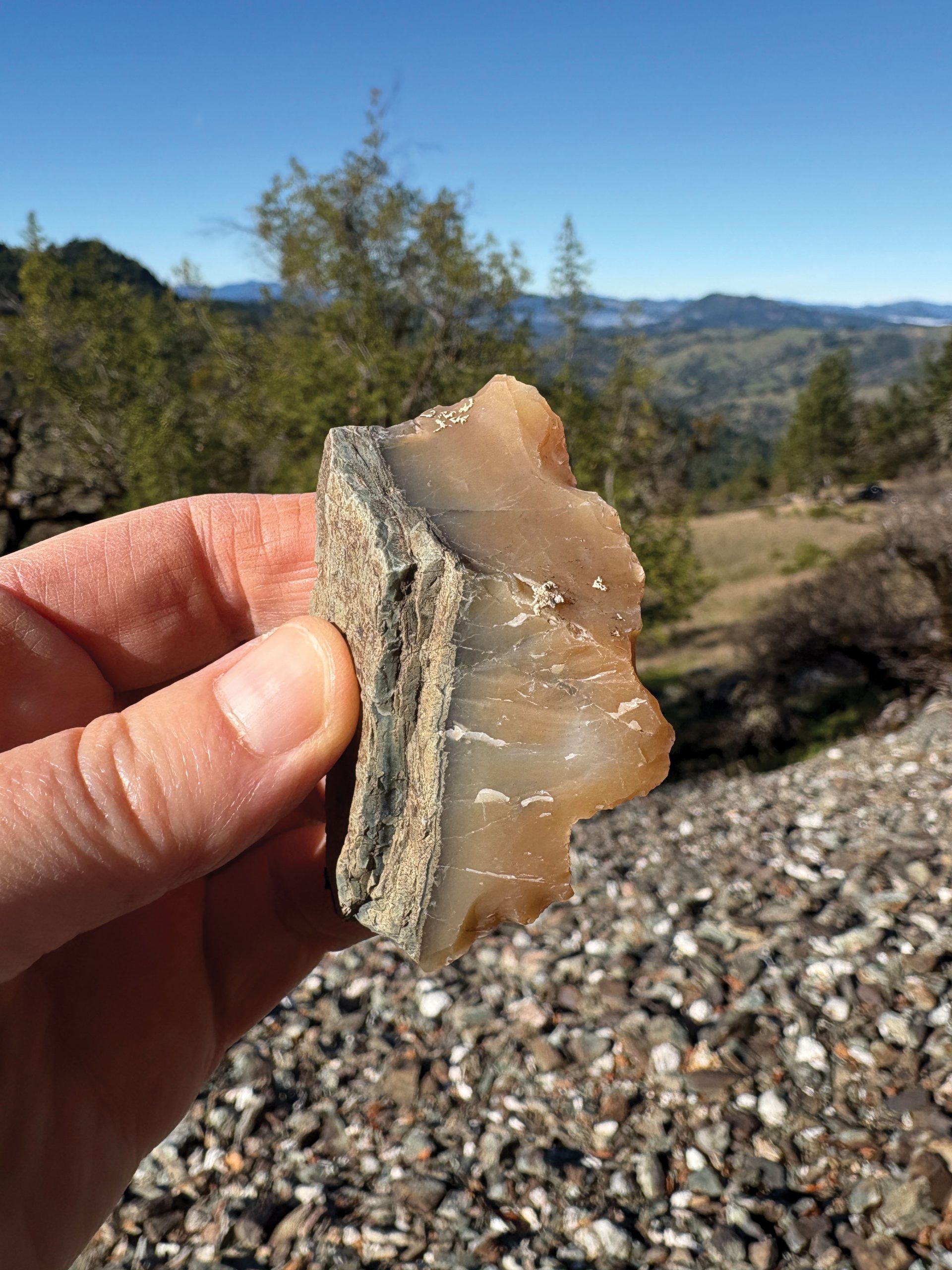
A primary flake of chalcedony demonstrates toolstone variation within the quarry.
Knowing the location of a dependable toolstone source would have been essential. It comes as no surprise that this extensive quarry, previously unrecorded by archaeologists, was known to the Eel River Wailaki, an Athabaskan-speaking Indigenous people who named it Se Nshong Duñ.
Michael Eldridge was a building contractor (now retired), and when a 40-acre property with sweeping views of the Coast Ranges came up for sale, he bought it as an investment with development in mind. In a small town such as Garberville, California, word travels fast. When Eldridge’s latest acquisition came up in conversation at a friendly barbecue overlooking the site, Traci Chadbourne Speelman, an Indigenous Eel River Wailaki, recognized the place and told him of its importance to her people. As a citizen of the Cherokee Nation of Oklahoma, he understood the need to protect the quarry and restore access to affiliated Tribal members and archaeologists. “As a native, once I realized the importance of Se Nshong Duñ, I couldn’t follow through with my original plan, and I dreamed that somehow it could be protected and made available to all native people, because as a native, I know that we need these physical connections. This was proven out when I invited Traci and family to the quarry; she made an immediate connection.”
Two lucky coincidences followed. The first was that while Chadbourne Speelman visited a site where Far Western Anthropological Research Group, a cultural resource management company (CRM), was providing archaeological compliance for a local project, she met two archaeologists working on the project. William “Bill” Bloomer and Denise Jaffke agreed to accompany Chadbourne Speelman to Eldridge’s property to examine the quarry. The second was that the Conservancy appeared in Eldridge’s social media feed. The culmination of these coincidences led to an email from him to the Conservancy’s Western Regional Director Linsie Lafayette.
Quarries come in many types and sizes. Some consist of a few tested cobbles from material ultimately deemed subpar or used only as a last resort. Others, including Se Nshong Duñ, contain plentiful, high-quality material with few imperfections that can produce sharp, durable edges. Stone from such sources may have been traded over long distances, and visits to important quarries may have been incorporated into seasonal movements across the landscape.
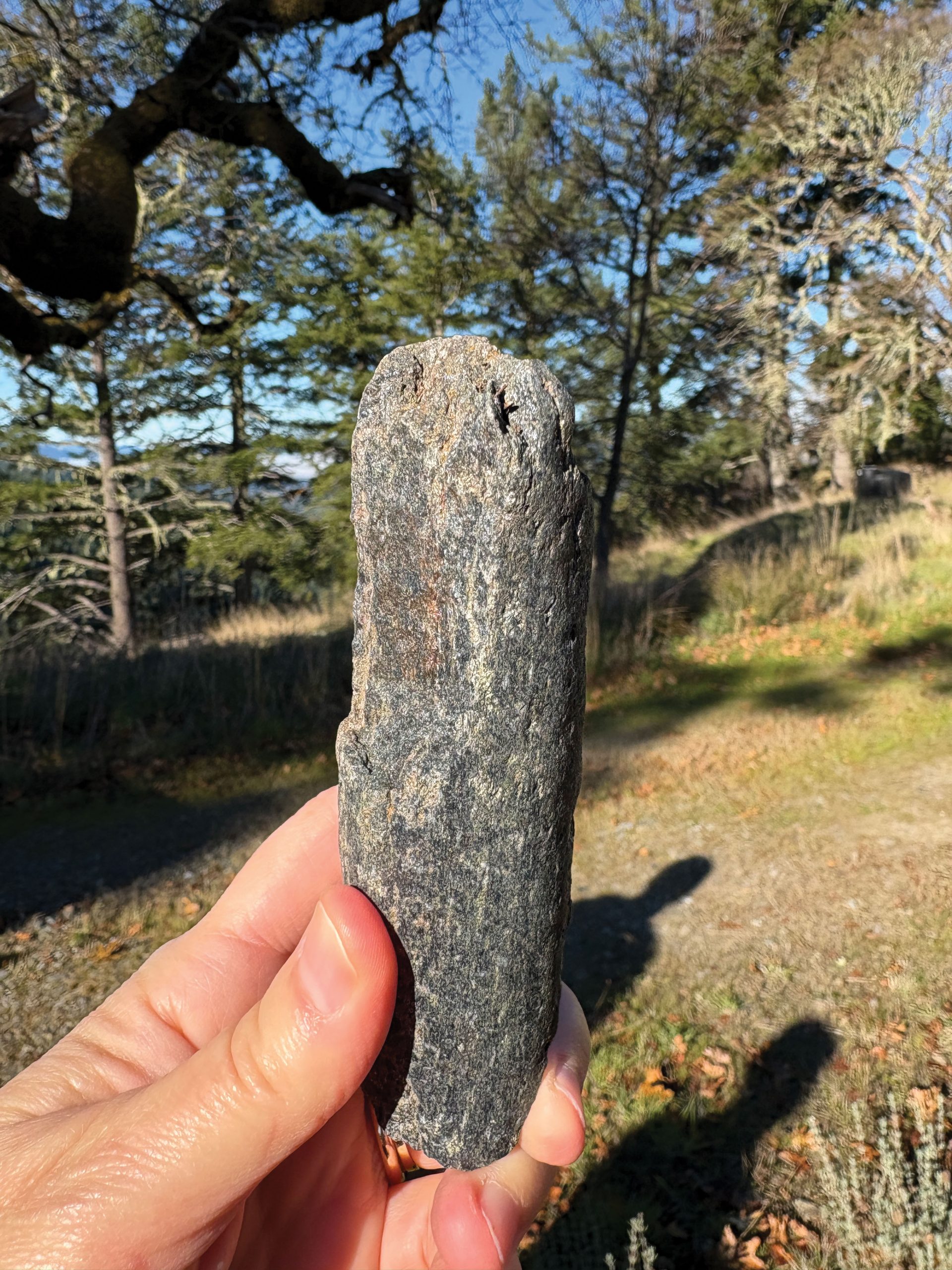
A pestle imported to the quarry and reused as a hammerstone.
Lafayette needed to know where this source fell within that range. Because the site had not previously been recorded, Bloomer’s testimony about its extent was invaluable. The following month, Lafayette made the six-hour drive from Reno, Nevada, to Garberville. Seeking further confirmation of the quarry’s archaeological importance, Lafayette arranged an on-site meeting with two local archaeologists: James “Jamie” Roscoe, former director of the cultural resources facility at Humboldt State University (now Cal Poly Humboldt) and currently running a CRM company, Roscoe and Associates; and Greg Collins, California State Parks district tribal liaison. Roscoe said there are several Franciscan chert quarries in the region, but this is one of the largest and most culturally significant he has seen.
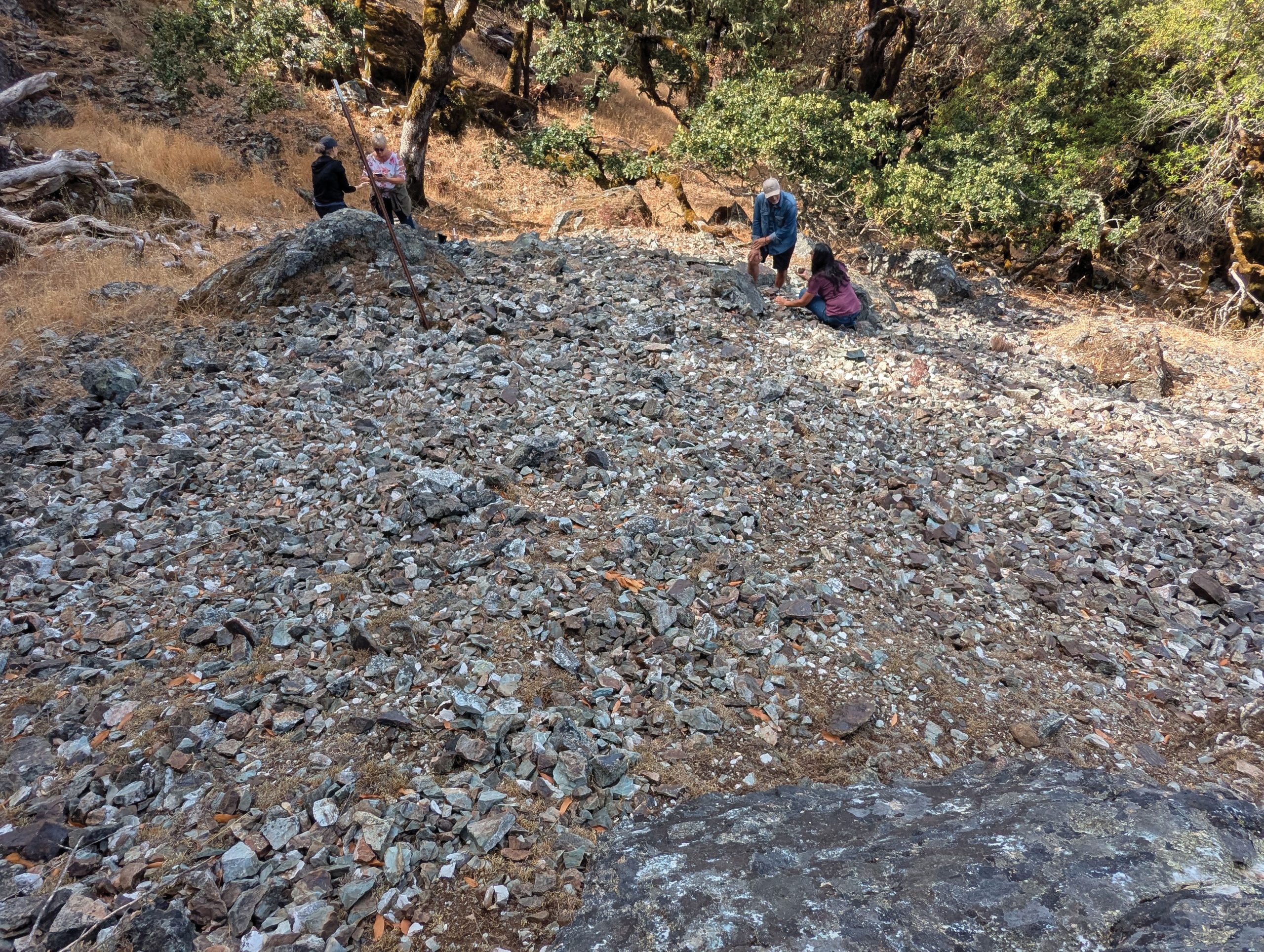
During the visit, Lafayette observed three acres—about two football fields—covered with primary toolstone shatter produced by thousands of years of stoneworking. Shatter is common at quarries because people often reduced cobbles to tool blanks or bifaces that could be carried away and refined elsewhere. Rocks are heavy. The shatter was not only extensive across the landscape but also cascaded down the hillslope into deposits of unknown depth. Beyond the main quarry were isolated chert outcrops surrounded by additional shatter, broken bifaces, and cores the size of a bowling ball.
Franciscan chert is commonly reddish-brown or green, but examples at Se Nshong Duñ were predominantly gray, but also included red, white, and tan varieties as well as translucent chalcedony. The tools used to strike flakes from local boulders and cobbles were also present. In addition to hammerstones, the investigators found grinding implements such as pestles and handstones that had been reused as hammerstones—an indication that activities more related to food processing than quarrying happened nearby.
But the most compelling argument for the Conservancy’s acquisition came from Chadbourne Speelman, who said, “The importance of this quarry site for cultural and historic education would be a great asset to the native and academic groups that would regain access to a site that has been held in private ownership for a very long time. This quarry, due to its size and scope, was a main source of toolstone for our past ancestors.”
For Eldridge, preserving the quarry meant more than protecting the artifacts and archaeological deposits found there. He wanted to restore access for local Indigenous people and researchers and asked that the preserve bear a name chosen by the Wailaki.
With the acquisition of Se Nshong Duñ, the Conservancy has now protected 600 sites since its founding in 1980. Together, these preserves encompass thousands of years of human history, from some of the earliest known occupations in North America to historic military, industrial, and community sites. Each acquisition began with a landowner, archaeologist, Tribal representative, Conservancy member, or concerned citizen recognizing that something irreplaceable could be lost.
Se Nshong Duñ illustrates why the Conservancy was created: to permanently protect significant archaeological places while preserving the knowledge they contain for descendant communities and future researchers. Its acquisition also demonstrates how that mission increasingly depends on relationships with Indigenous communities whose histories—and continuing connections to the land—give these places meaning beyond the archaeological record.
The Conservancy thanks Michael and Carolyn Eldridge for entrusting this important place to us and Traci Chadbourne Speelman for recognizing its significance, helping reconnect the quarry with her community, and working with the Wailaki to give the preserve its fitting name: Se Nshong Duñ, “Good Rock Place.”
LINSIE LAFAYETTE is the Conservancy’s Western Regional Director. Editor Tracy Loe contributed to this report.