
By Tamara Jager Stewart
In the middle of the Chihuahuan Desert of northern Mexico, the magnificent adobe city of Paquimé seems to rise out of nowhere. In the 14th century, it was an impressive center—one of the largest and most complex ancient communities north of Mesoamerica. The 90-acre city was built of multi-story adobe walls and contained effigy mounds and ballcourts, an elaborate hydrological system fed by a nearby spring, and five large earthen ovens central to the center’s ritual ceremonies and accompanying feasts. Designated a UNESCO World Heritage Site in 1998, the city was the center of a regional cultural tradition known as Casas Grandes that extended into Sonora, Chihuahua, New Mexico, and Arizona between A.D. 1130 and 1450.
For decades, researchers assumed that a center with such strong Mesoamerican features—and a highly innovative water system with underground drains, reservoirs, and canals delivering potable water to residents’ houses—must have been built by foreigners, merchants from Mexico or Ancestral Puebloan leaders of the Chaco center to the north. But an explosion of recent research—from settlement surveys, excavations, and burial data to detailed aerial imagery and ancient DNA analyses—is forcing archaeologists to question this and to dig deeper beneath the city and across the region in search of Paquimé’s origins. This has led them to a shared conclusion: what was long believed to have been inspired by foreigners is now thought to be a local phenomenon. While debate continues over the nature of the center’s rise to power, reign, and decline, researchers now have far more data with which to test and revise older views.
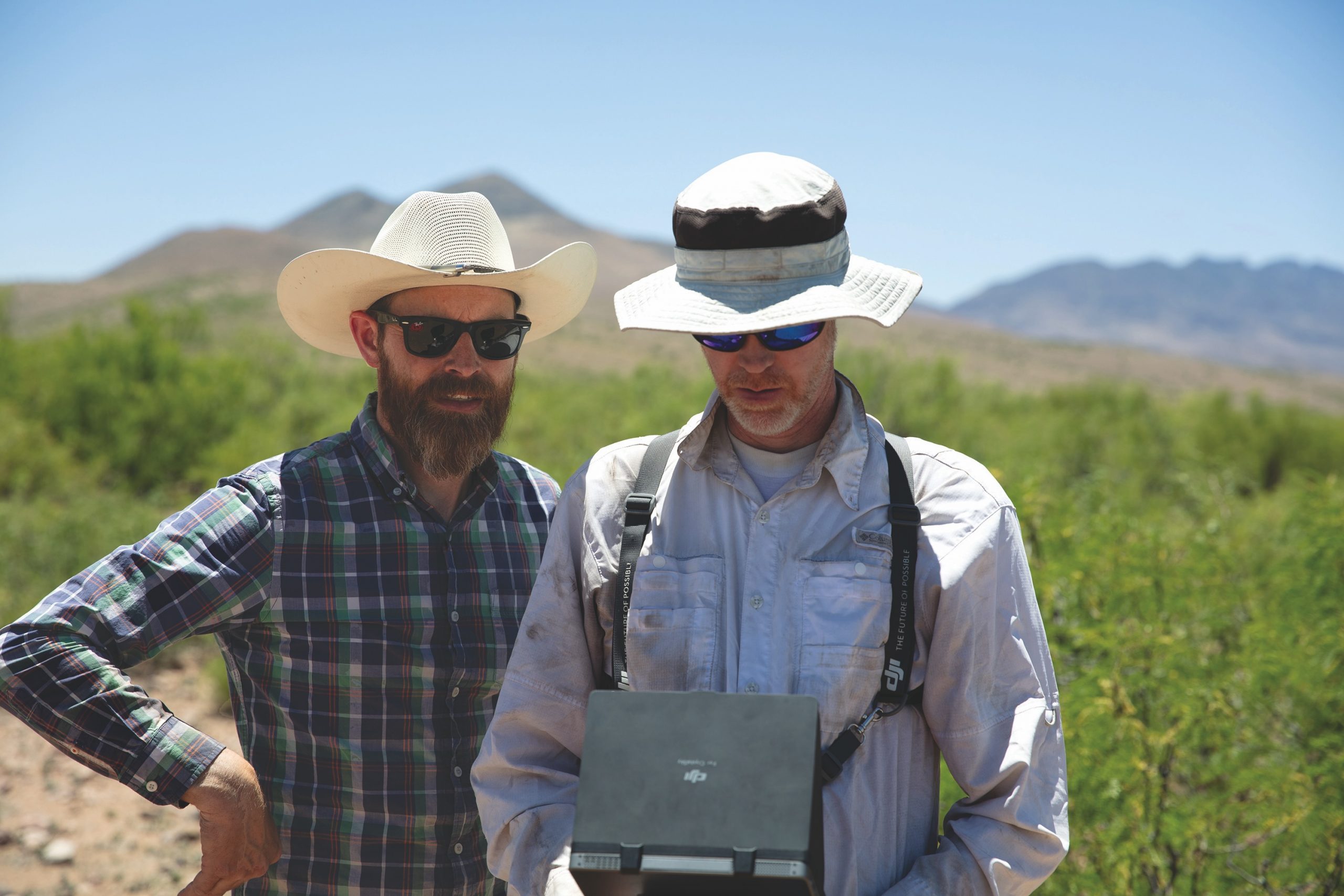
Dr. Michael Searcy,
left, and Dr. Scott Ure
watch live drone footage
from the Gateway X100
UAS (below) flown over
Paquimé and San Diego
sites in 2015.
Photo courtesy of
Dr. Scott Ure.
Archaeologist Dr. Charles Corradino Di Peso of the Amerind Museum and Eduardo Contreras, the Mexican governmental representative who oversaw parts of the project, carried out the first large-scale, systematic (modern) excavations at Paquimé and the adjacent early Convento site between 1958 and 1961. As is common at monumental sites such as Paquimé, early research focused on the center itself and the Medio period during which it arose, leaving many questions surrounding the relatively little-studied preceding Viejo period. …
“Di Peso essentially interpreted Paquimé in a vacuum, as almost no other research had been done in the region,” said Dr. Michael Whalen, professor emeritus at the University of Tulsa. “He saw heavy, definitive Mesoamerican influence at Paquimé and interpreted the city as a hierarchical, Postclassic Mesoamerican society imposed on a simpler, local culture from outside. He also dug Viejo period pit houses and saw a chasm between these and Paquimé, taking what he found at Paquimé as definitive of the Medio period during which it arose. For decades, there was no new data to evaluate this model.” This has raised a few big questions: Was there really a cultural hiatus between the preceding Viejo period and the subsequent rise of Paquimé? Were the Medio period ceramic assemblage and architectural style truly new introductions from Mesoamerica? How hierarchical was Paquimé and how centralized and comprehensive was its authority? “Paquimé is no more mysterious than Chaco Canyon, Mesa Verde, or the Classic Hohokam. It has just been studied far, far less,” said Dr. Paul Minnis, professor emeritus at the University of Oklahoma. “Consequently, people tend to view Paquimé from their region’s perspective: people north of the border see the ‘Southwest’ character of Paquimé; those in West Mexico see the West Mexican character. This is not surprising given the lack of regional research placing the Casas Grandes archaeological tradition within its local context.”
To address this gap in knowledge, Whalen and Minnis have conducted surveys and excavations in the region since the 1980s, recording nearly 400 Medio period sites and excavating portions of nine sites. Minnis and Whalen found Viejo period pottery, features, and structures under all the large, excavated Medio sites (including Paquimé), confirming what they’ve long argued: that Viejo inhabitants occupied the same prime farming locations as their Medio period successors. Their work at a nearby neighbor of Paquimé provides a clear stratigraphic sequence of Viejo period pit houses, jacal surface structures, and adobe-walled pueblo rooms. The same was found at Paquimé.
“We contend, therefore, that there is a clear developmental sequence in the region’s architecture and ceramics from the Viejo through the Medio periods,” Whalen said. “The Casas Grandes region was far from an empty niche into which Medio populations expanded. Instead, the Viejo period settlement pattern appears to represent a smaller version of what we found in the succeeding Medio period.”
This is an excerpt of ‘Revealing the Roots of Casas Grandes’ in American Archaeology, Spring 2026, Vol. 30, No. 1. Subscribe to read the full text.