
By Gayle Keck
Moonshine. The word conjures gangsters, muscle cars, wily hillbillies, and jars of white lightnin’. Archaeologists increasingly see something else: evidence of creativity, resilience, economic survival, and tradition. Yet the still sites that preserve those stories are often mistaken for dumps or debris scatters, overlooked during cultural resource management surveys, disturbed during searches for more ancient remains, or dismissed as too recent to warrant protection. Archaeologist Cassandra Mills argues that studying them can reveal how people responded to economic and environmental challenges—and provide a perspective largely absent from records created by law enforcement. Dr. Katherine Parker of the University of Mary Washington agrees that archaeology can produce more concrete evidence about the people who made moonshine than historical records alone. Dismissing the sites because researchers believe they already understand moonshine, she said, means losing opportunities both to tell a fuller story and to engage a public already fascinated by this compelling part of American history.
Producing liquor indeed has deep roots in American history; even George Washington had a distillery at his home, Mount Vernon. With water—and, in some cases, even milk—hazardous to drink, beer, cider, and liquor were common household products. “From 1790 to 1830, Americans drank more alcohol than has ever been recorded in the United States before or since, thus demonstrating the cultural and socioeconomic importance of alcohol,” Mills wrote. Archaeologist Dr. Kirk French, of Penn State University, noted that from the earliest days of whiskey production in the United States, whiskey was a tangible commodity. It was often used in lieu of cash, traded for services, given as a gift, and even used to buy votes in local, state, and federal elections.” However, he added that it also involves examples of intangible commodities, like knowledge, skills, and information. “Whiskey acts as a stable store of value,” said political economist Dr. Emelie Peine, of the University of Puget Sound. She said it was often made from materials that are inexpensive or freely foraged, and once made, it can be stored for long periods of time.
The typical narrative says that distilling traditions were brought to the Appalachian region by Scots-Irish settlers, although the practice was eventually much more diverse and widespread. Most early settlers were hunters and subsistence farmers, living in remote mountain areas where it wasn’t easy to get surplus crops to market. They soon calculated that corn converted into liquor was far more compact and better-preserved than the grain itself. Mills noted a single horse could haul 10 times more value in whiskey to market than corn. By the early 19th century, more than four million gallons of liquor were exported annually from Appalachia.
One of the young country’s first federal taxes was levied on alcohol, to help pay debt from the Revolutionary War. Washington led troops to Pennsylvania to put down the resulting Whiskey Rebellion, where irate producers tarred and feathered revenue collectors. Alcohol was taxed again following the War of 1812 and the Civil War—and those taxes prompted some small distillers to produce illicitly. “What do you do? Do you try to make it legally?” said Dr. Daniel Pierce, emeritus professor at the University of North Carolina, Asheville. “Because they were very small producers, they’d make no profit if they paid the excise tax. Do you quit doing it, or do you become a moonshiner? For so many people, it was not much of a choice.”
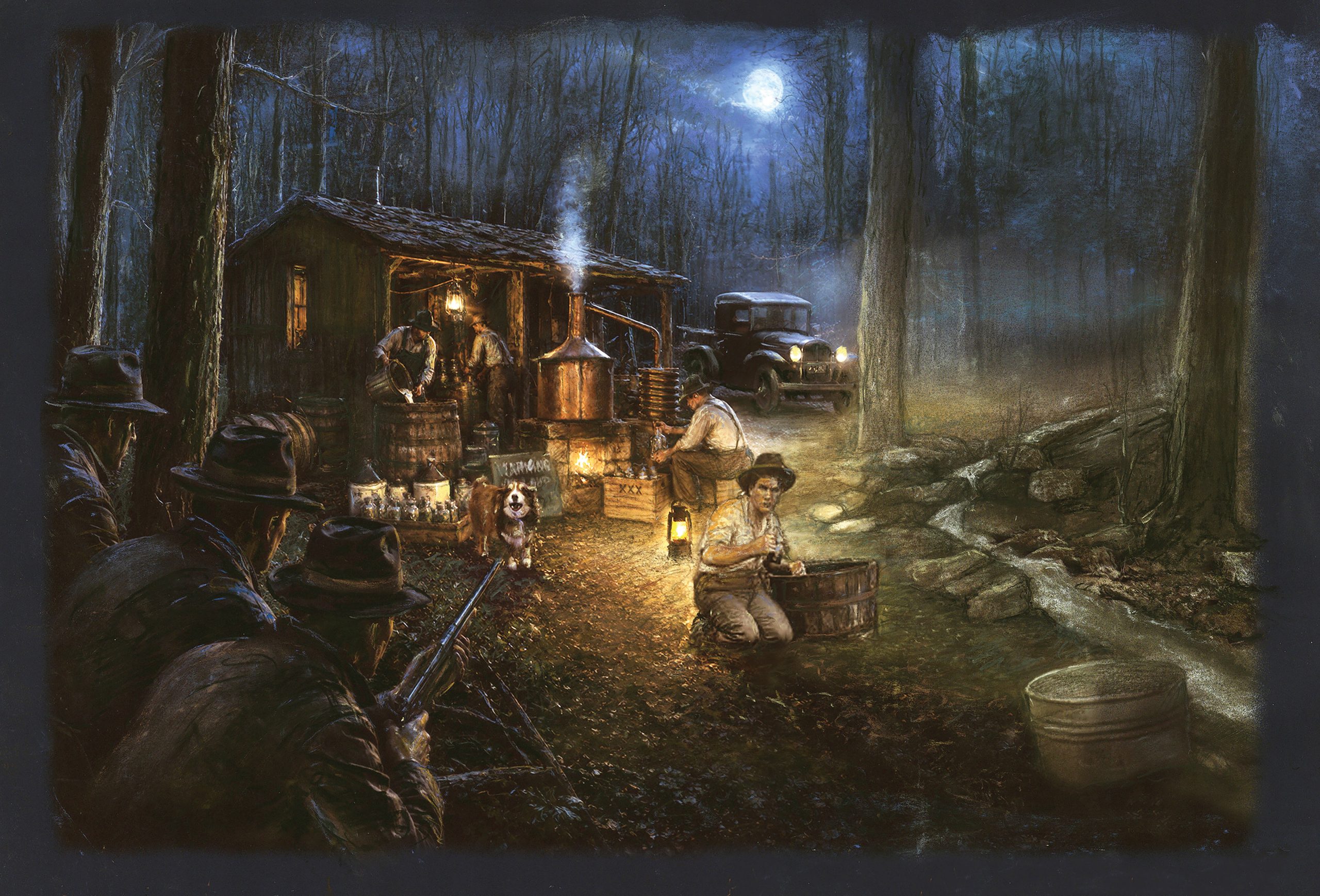
The term “moonshining” originated in Europe to indicate any type of illegal activity performed under the cover of darkness. For American distillers, night hid the telltale smoke from still fires. To avoid detection, stills were moved away from homesteads and into woods, caves, or swamps. Moonshining only escalated as counties went “dry” or states restricted legal liquor sales to state-run stores. And with the advent of Prohibition, in 1920, moonshining became big business.
If archaeologists are to preserve these places, however, they first have to recognize them—and still sites were designed not to be found. So, how do archaeologists identify still sites? “They are all in the middle of nowhere,” said archaeologist Chris Espenshade, who encountered dozens while conducting a CRM transmission-line survey in North and South Carolina. “On a steep side slope, we’d run across a little creek, and there would be a still site. Nobody’s going to come across them by accident. The price of secrecy is there’s a lot of labor hauling stuff in and out.” During the survey, he estimates they encountered a site every five miles.
This is an excerpt of ‘Still Here’ in American Archaeology, Fall 2026, Vol. 30, No. 3. Subscribe to read the full text.