
By David Malakoff
On a frigid fall day in 1952, an avid amateur archaeologist named Maynard Green took a moment to write a letter to Lloyd Wilford, a prominent archaeologist at the University of Minnesota. Green, then 33, had spent much of his life exploring the fields and forests around his home near Grand Meadow, a small farming community in southeastern Minnesota. He had developed a keen eye for finding artifacts and spotting potentially important sites, including one in a small woodland a few miles from his home. “There is a locality… that has puzzled me for a number of years,” Green wrote. “[N]early the whole thing is covered with pits and mounds,” and “in the cultivated fields around this patch of timber, there seems to be an abundance of a gray or whitish flint. It is my theory that this is an old indian flint quarry. Could this be possible?” he asked, adding that he’d be eager to show Wilford the site if interested.
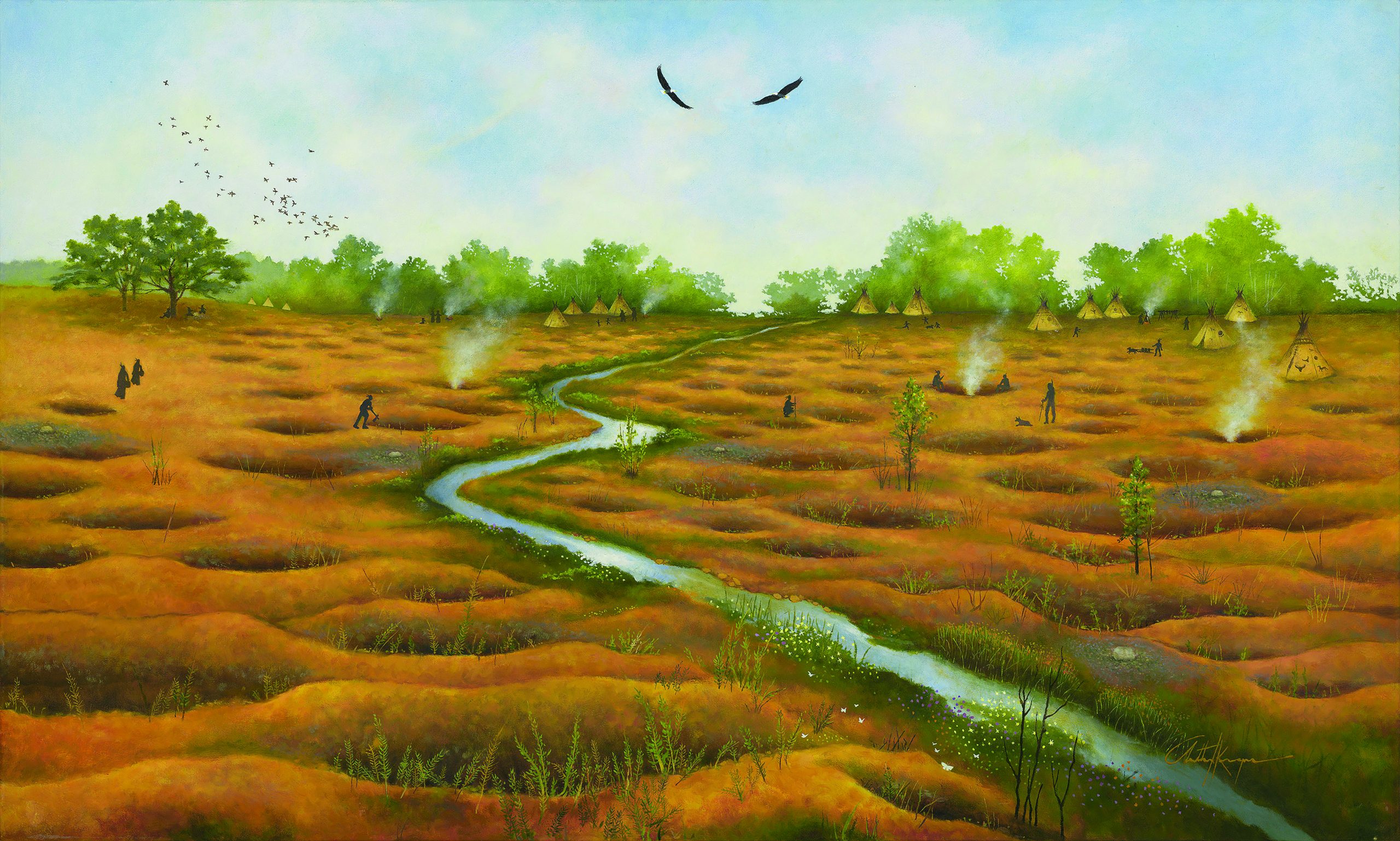
Wilford ultimately did make the 100-mile trip from Minneapolis to Grand Meadow, but a fast-moving prairie storm cut short his visit, and the two men never made it to the woodland. Neither of them knew that nearly 30 more years would pass before researchers realized that Green had identified one of Minnesota’s most important archaeological sites and pinpointed its purpose. “If it hadn’t been for Maynard, we probably wouldn’t be talking about the Grand Meadow Chert Quarry today,” said archaeologist Tom Trow, who in 1980 agreed to a colleague’s request to meet with Green while conducting nearby surveys for the Minnesota Historical Society. “He asked, ‘Would you talk to this guy? He’s been waiting a long, long time,’” Trow recalled. Green led the way to the pitted woodland, and “I was just gobsmacked—it was the most astonishing landscape I’d ever seen as an archaeologist,” Trow said. He quickly recognized that the remarkably well-preserved site had once been a key source of raw materials for Native American toolmakers. Everywhere he looked were flakes of the glassy, fine-grained sedimentary rock known as chert or flint, along with a large number of pits dug by ancient miners. “Every square inch of earth had been altered; there was either a hole or a pile of dirt. It was like walking through a disordered egg carton.”
Trow and others soon helped launch a decades-long, multifaceted effort to study and protect the quarry, which is the state’s only known intensively utilized Indigenous chert quarry with visible mining pits.
In 1994, it was added to the National Register of Historic Places as the Grand Meadow Quarry Archaeological District and purchased by The Archaeological Conservancy. And last summer, the site—now known as The Grand Meadow Chert Quarry / Wanhi Yukan Archaeological & Cultural Preserve—began another chapter in its remarkable history with the opening of the Wanhi Yukan Trail. The nearly mile-long path leads visitors past a dozen interpretive signs that tell the site’s story in both English and Dakota, a language spoken across parts of the northern Plains and Upper Midwest. (In Dakota, “Wanhi Yukan” means “there is chert here,” while Minnesota itself derives from the Dakota term “Mnísota,” meaning “the land where the waters reflect the skies.”) The trail “is now allowing people to really see and learn about this hidden gem, which few people knew about,” said Forster, the executive director of the Mower County Historical Society, which partnered with the Prairie Island Indian Community, the Conservancy, and government and private donors to complete the project.
This is an excerpt of ‘There is Chert Here’ in American Archaeology, Summer 2026, Vol. 30, No. 2. Subscribe to read the full text.