

By David Malakoff
On a warm day earlier this year, a pair of canoers guided their sleek craft down the meandering Wabash River near Lafayette, Indiana, their paddle blades flashing rhythmically in the sun. The boaters were just out for a bit of fun. But they were also retracing a historic water trail that, in the 1700s, served as a crucial lifeline for Native Americans and newly arrived European colonists engaged in the lucrative fur trade. For decades, canoes laden with beaver pelts and other goods traversed the 500-mile-long Wabash’s roiling rapids and placid pools, pausing to load and unload cargo at European trading posts and Native American villages along the river.
Now, archaeologists are getting a clearer picture of one significant Wabash River fur trading center: Fort Ouiatenon (pronounced We-ah-teh-non), which became Indiana’s first permanent European settlement in 1717, when the French established it some five miles downstream of modern-day Lafayette. For nearly 75 years, the outpost, named after the Wea people who lived in what is now western Indiana and southeastern Illinois, played a prominent role in the competition among Native American, French, and British groups to control the region. Over time, however, the stockade’s location was forgotten, as floods buried its remains in mud and the river’s shifting channel dramatically reshaped the landscape. But in the late 1960s researchers rediscovered the fort, launching what has become a multifaceted effort to study and preserve the site, which the federal government designated as a National Historic Landmark in 2021.
In recent years, that effort has become more vibrant than ever as several groups—including The Archaeological Conservancy—have collaborated to create the Ouiatenon Preserve, which now owns and protects some 320 acres of fields and forests, including the site of the fort. Archaeologists, meanwhile, have been working to analyze the trove of artifacts that have been recovered from the site over the past 50 years, and pursuing new efforts to document the Native American settlements and other features that sat outside of the fort’s walls. This past summer, those investigations got a boost from a month-long field school at the Ouiatenon Preserve that included using state-of-the-art ground penetrating radar to detect buried features and excavations aimed at understanding the purpose of two substantial, but enigmatic trenches cut deep into the landscape.
The fieldwork represented a rare opportunity to better understand one of the few fur trade-era sites that has not been obliterated by bulldozers or entombed beneath tons of concrete, said archaeologist J. Colby Bartlett, the preserve’s director and the son of Joseph “Del” Bartlett, who helped rediscover the site of the fort nearly 60 years ago. “This is a place where two cultures, from different sides of the world, came into very close contact,” he said. “It opens a window into this remarkable period of exchange and lets you see the real fabric of cultural interaction.”
This is an excerpt of ‘Connected Cultures Along the Wabash,’ in American Archaeology, Fall 2025, Vol. 29, and No. 4. Subscribe to read the full text.
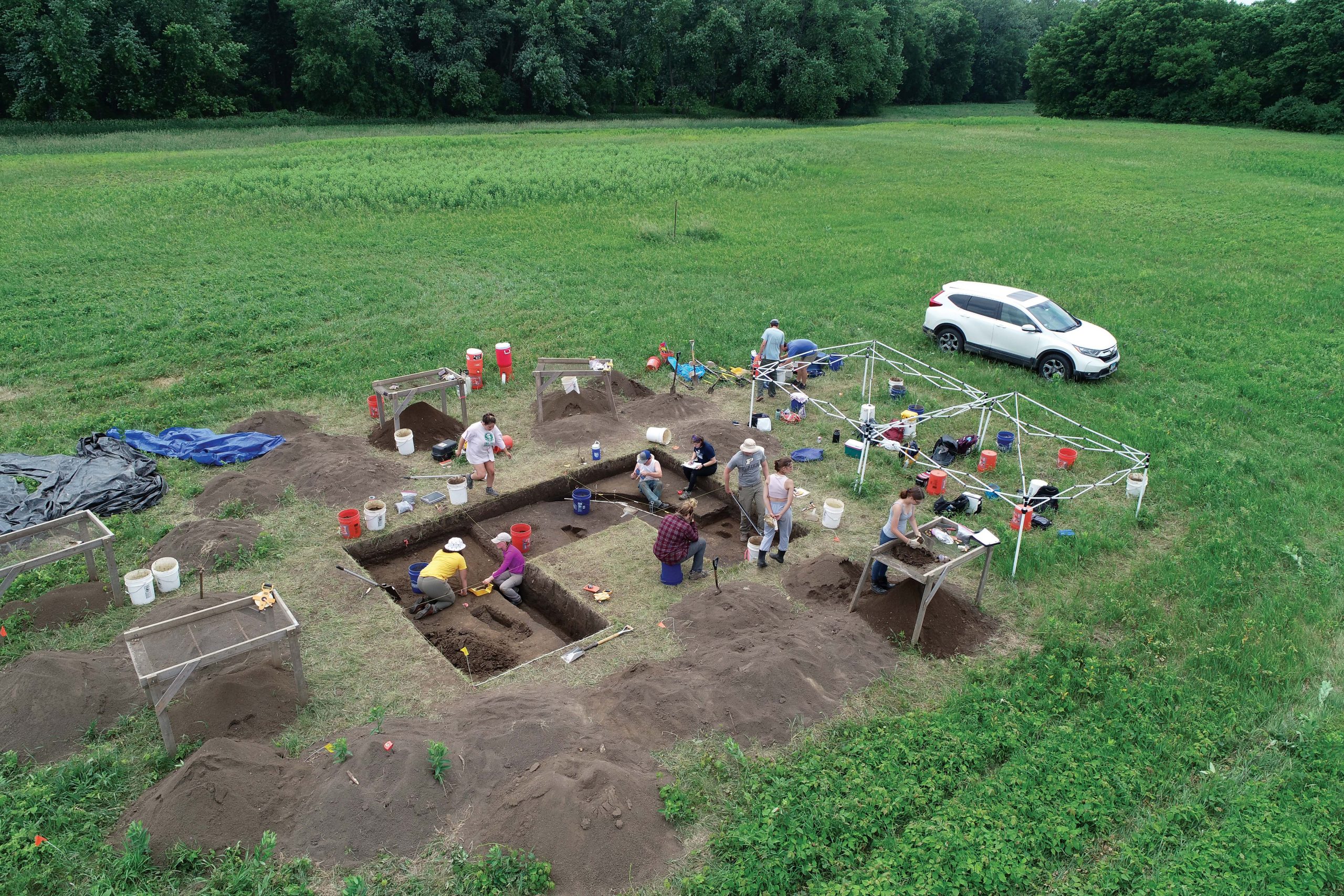
Drone aerial view from 2022 of the excavation site of a possible Metis dwelling outside Fort Ouiatenon’s palisade. Photo by Dr. Ian Lindsay