
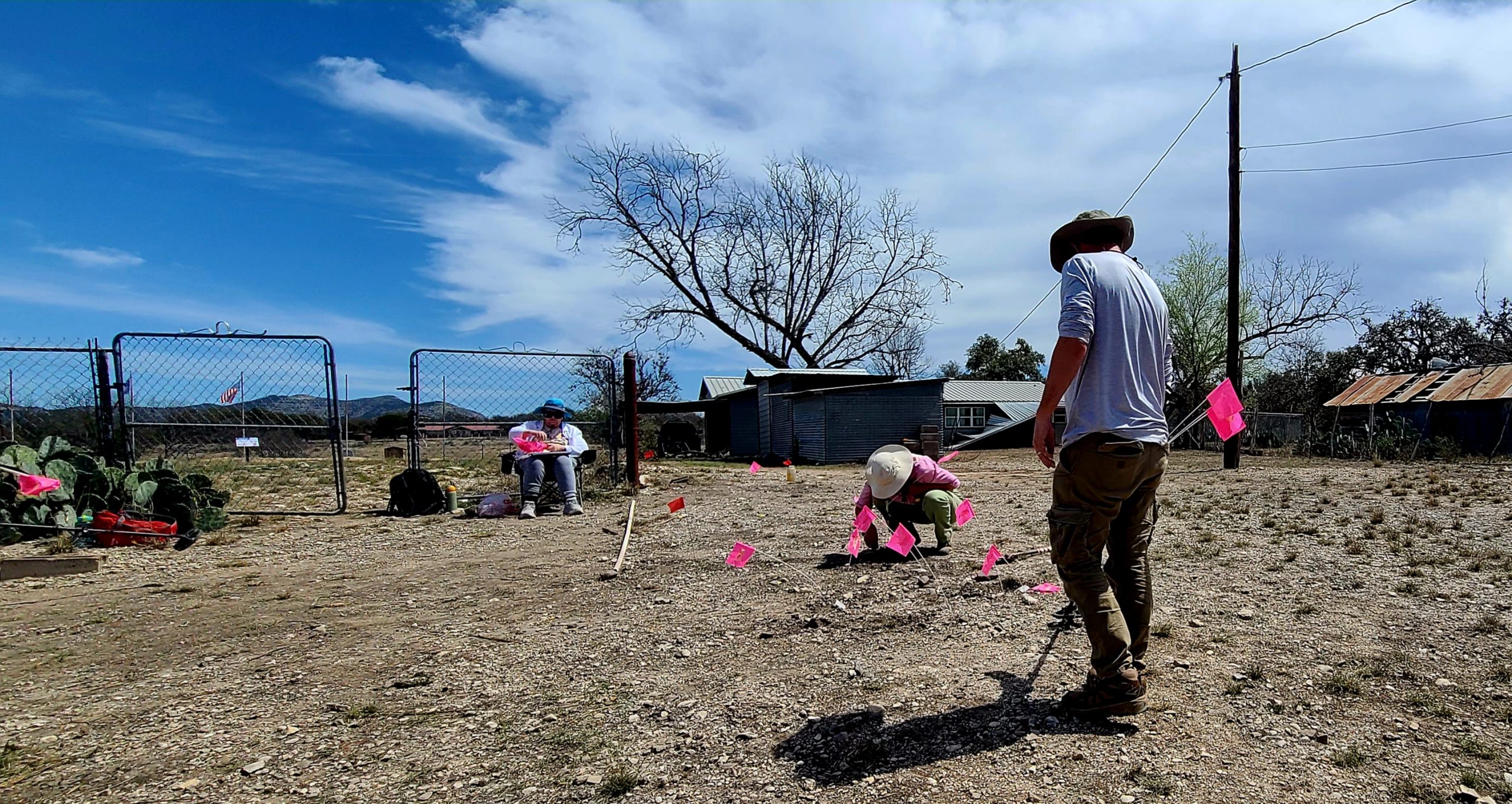
Camp Wood Preserve was the subject of a workshop in March aimed at providing archaeology students with practical skills in metal detection survey methods. The workshop was hosted by Charles Haecker from Advanced Metal Detecting for the Archaeologist (AMDA), a nonprofit, volunteer organization that offers courses for archaeologists to learn new technologies and field methodologies.

One notable find was a Catholic patron saint medal once distributed at the mission. Photo by April Brown / TAC
With Haecker, archaeologist Tamra Walter, Ph.D., led a group of students from Texas Tech University to explore areas of the preserve on the southern and western boundaries of the mission walls. While the mission property has been excavated and explored in the past, the property within the new preserve has never been formally researched.
The early part of the workshop centered on the western boundary of the mission where it is speculated that the Lipan Apache camped when they visited Mission San Lorenzo, and some interesting artifacts were uncovered. Musket shots were found across the project area, some showing evidence of hitting a hard enough surface to flatten them. A button from a Spanish soldier’s uniform was also found, along with gun parts and a possible book clasp. One of the more interesting finds was a Catholic religious metal that would have been distributed to visitors and residents of the mission. In addition to metal objects, there were also unique pottery fragments, numerous gun flints, and stone tools. A formal report on the project is expected from Texas Tech University by the end of the summer.
More than 100 artifacts were discovered during the four-day workshop. The number and variety of artifacts was surprising considering that the property had been scraped during development sometime in the 1960s. Many of the artifacts were found just below the surface, barely missing the scraper’s blade. This small research study demonstrates the importance of preserving properties like Camp Wood Preserve. Although this site has been disturbed in the past, there is still important archaeology preserved in the ground that is helping us piece together the daily lives of the Spanish and Lipan Apache who lived and visited the mission in the late 18th century.