

By Paula Neely
Seamus, an 8-year-old yellow lab, gazed attentively at his handler, Kathleen Connor, waiting for her signal to begin surveying a potential unmarked historical burial area at Forest Hill Park in Richmond, Virginia, last summer. As soon as Connor swept her right arm from left to right, Seamus began sniffing the ground for odor left by decomposed human remains buried almost 200 years ago. Within minutes, he sat down, alerting that he detected the odor of remains beneath the surface. Connor explained that dogs alert by sitting or lying down at the place where the odor is the most concentrated. A few hours later, Abby, a 6-year-old chocolate lab, surveyed the same area and confirmed the possible presence of human remains in the same spot Seamus had identified.
The canine surveys were conducted under the direction of Paul Martin, of Martin Archaeology Consulting, to help identify where people had been buried on the grounds of a plantation established by Holden Rhodes in 1836. After Rhodes’ death, the property changed ownership several times, and by the 1870s, it was mostly abandoned. In the 1890s, it became an amusement park until it was acquired by the City of Richmond in 1934 and developed as a city park. The stone house built by Rhodes in 1836 was renovated for community use and the park manager’s residence. Today, there are pickle ball and tennis courts, a playground, picnic shelters, and walking trails.
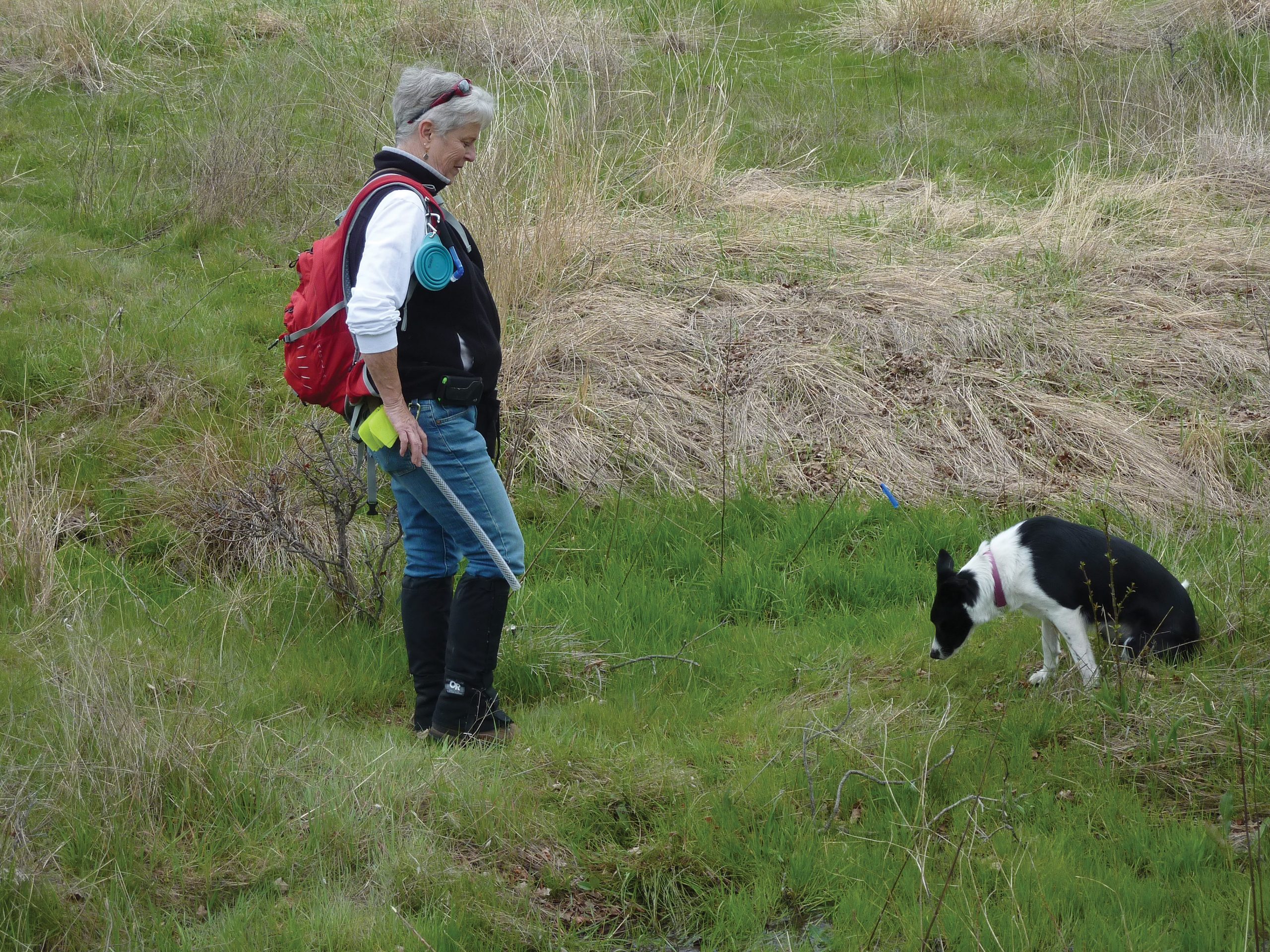
ICF canine handler, Lynne Engelbert, watches as canine Piper alerts on the odor of human remains. Piper and Lynne were one of four canine teams sent to search for pilot Amerlia Earhart’s remains on the remote island of Nikumaroro. Photo by Adela Morris.
When Martin conducted ground penetrating radar (GPR) in the area identified by the dogs and recorded by GPS, he discovered “what appears to be the potential for multiple child or subadult burials.” He said the area was located to the west of the reserved area for the cemeteries for the Rhodes family and enslaved people described in historic documents. According to Martin, “Sometimes children were buried outside the known boundaries of a cemetery due to religious beliefs.”
Using dogs to initially survey an area is more cost-effective than using ground penetrating radar to cover the same area, he noted. “You can home in on anomalies and then do GPR.” Martin has used his dogs to help locate burials at numerous historic cemeteries and battlefields throughout the U.S. He also surveyed areas in the Philippines, Germany, France, and Belgium to help History Flight locate service members who were missing in action during World War II. He and his dog identified at least three burials that were exhumed and repatriated to the United States. DNA confirmed their identities, and they were buried with full military honors.
Although human remains detection dogs, also known as cadaver dogs, have been used by criminal investigations and search and rescue (SAR) operations since the 1970s, dogs have only been used to detect historical and archaeological human remains since the 1990s. “The dog’s olfactory system is so much more enhanced than ours. They have eight million receptors compared to our three million,” Martin explained. “The portion of their brain committed to olfactory process is also 80 percent larger than ours.” Dogs can distinguish hundreds of different odors that humans can’t.
This is an excerpt of ‘Scenting the Past’ in American Archaeology, Winter 2025, Vol. 29, and No. 4. Subscribe to read the full text.