
By David Malakoff
It was “the most disastrous defeat ever inflicted on an American army,” Historian John Fiske wrote in 1891. On a sweltering August morning in 1780, a British force of roughly 2,000 troops needed just an hour to rout an American army of nearly twice its size in the swampy pinelands north of Camden, South Carolina. The “total and ignominious defeat” fueled fears that the rebellious colonies would lose their fight for independence. Those worries ultimately proved unfounded, but over the next two centuries historic preservationists would largely ignore the site of the Battle of Camden while moving to protect Revolutionary War battlegrounds associated with more uplifting victories.

Dr. Stephen Humphreys (center), founder and CEO of AVAR and principal investigator of its Camden Battlefield project, speaks with veterans following a morning briefing on the battlefield. Photo by Chris M. Rogers / American Battlefield Trust
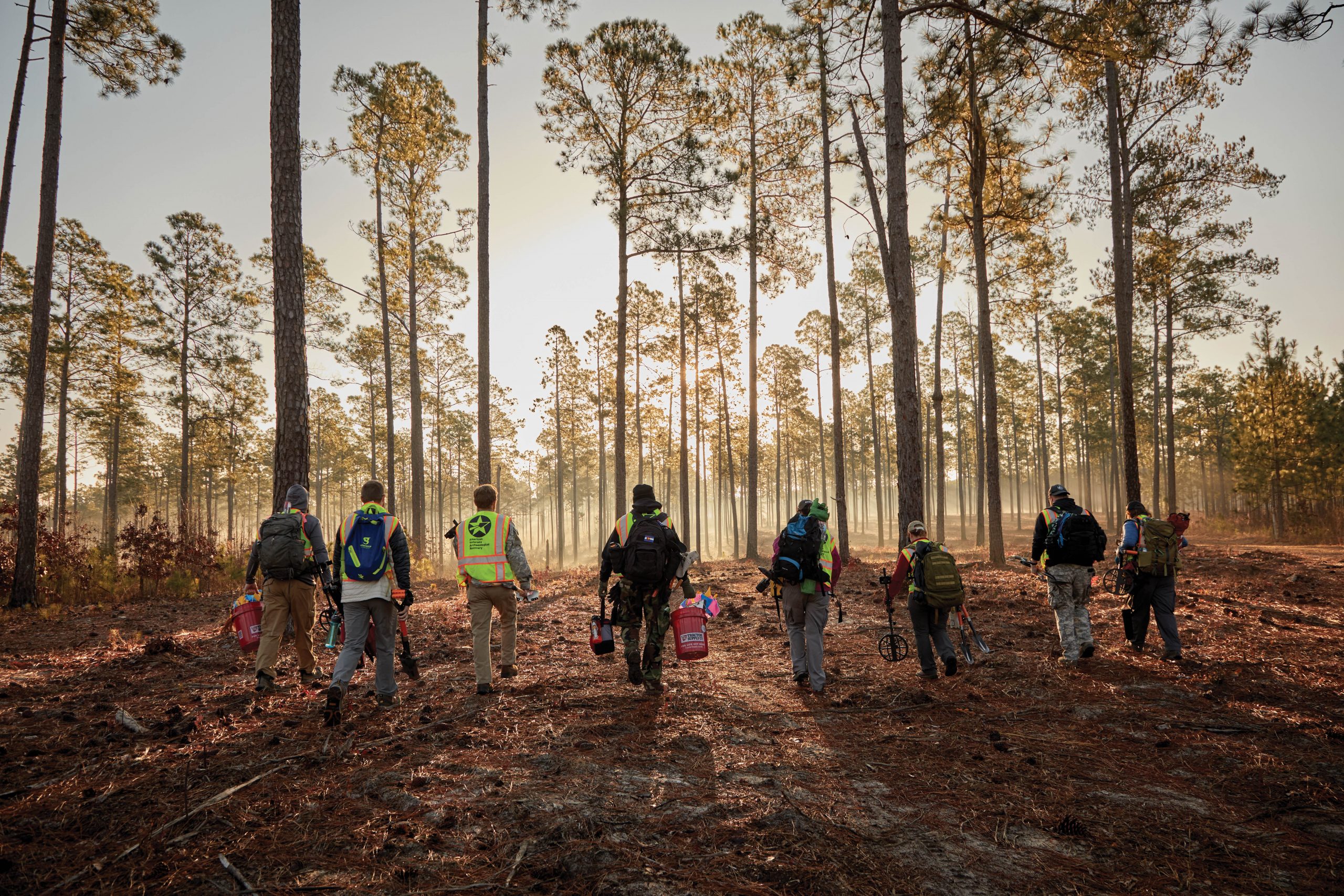
In recent decades, however, efforts to safeguard the Camden Battlefield have gained ground, and a handful of archaeologists (prominent among them James Legg and Steve Smith) have worked to document what the combatants left behind in its sandy soil. That effort got some fresh reinforcements earlier this year from American Veterans Archaeological Recovery (AVAR), an innovative program that uses archaeological fieldwork to help veterans transition to civilian life and, if interested, pursue careers in cultural resource management (CRM). In the first phase of what is expected to be a multi-year project, an AVAR team that included roughly a dozen veterans spent a month using state-of-the-art metal detectors and other tools to survey the Camden Battlefield and the nearby site of a British fort.
One goal of the Camden project is to better understand exactly what happened on that fateful morning nearly 250 years ago, said archaeologist Stephen Humphreys, a U.S. Air Force veteran who founded AVAR in 2016. Accounts of the clash typically blame the defeat on members of an American militia who were quick to panic and flee, he explained in February as he walked the battlefield, now partly covered by brush and a blanket of pine needles dropped by spindly trees.
“But it’s possible the militia’s been maligned,” he said. “If there is one thing we’ve learned from conflict archaeology over the last 25 years, it’s that the archaeological record sometimes conflicts with historic accounts, which can have a bias depending on who wrote them.” But the greater purpose of the project, Humphreys noted, is to advance AVAR’s mission, which is to empower veterans and “help them transition to the next phase of their lives,” Humphreys said. “We achieve that is by doing quality archaeology with military precision.”
Over nearly a decade, AVAR teams have carried that mindset to dozens of digs across the United States and in Europe and the Middle East. The sites often, but not always, involve conflicts, ranging from the French and Indian War of the mid-1700s to World War II. And while the field work can be grueling, it can have life-altering benefits, said Dan Fortier, an Army veteran who has struggled with a service-related injury and has been working on AVAR projects for several years.
“Being able to work on the digs has been a huge deal for me,” he said. “It has enabled me to start living again.”
This is an excerpt of ‘Digging the Past, Building Futures,’ in American Archaeology, Fall 2025, Vol. 29, and No. 3. Subscribe to read the full text.
Join us Nov. 13 at 5 p.m. MT for a free virtual lecture with Dr. Stephen Humphreys.
Register here: https://bit.ly/4oumQPx
After registering, you will receive a confirmation email containing information about how to join.
NOTE: As an alternative, we will also be broadcasting live on Facebook. A Facebook account is not required to watch or ask questions on Facebook Live. Those who cannot attend the live event will be able to watch the recording on our YouTube channel the next day.
About the Lecture:
Archaeology can help people—when it’s properly resourced and managed. Since veteran-oriented projects began to appear in the United Kingdom more than a decade ago, they have been instrumental in popularizing the idea that fieldwork can benefit participants.
Nearly a decade of experience working at the intersection of archaeology and veterans’ welfare has provided the 501c3 nonprofit American Veterans Archaeological Recovery (AVAR) with a more nuanced view of what archaeology can do for military veterans, but more importantly has demonstrated what military veterans can offer to archaeology. This presentation will introduce current research on the interaction between fieldwork and mental health and will detail AVAR’s unique approach.
About the Presenter:
Stephen Humphreys co-founded AVAR in 2016 and serves as its CEO. Prior to his graduate studies, he was a commissioned officer in the United States Air Force, deploying in support of Operation Iraqi Freedom and Operation Enduring Freedom. He has carried out dozens of excavations alongside American military veterans and specializes in developing methods to use archaeology to deliver tangible benefits to veterans.

Dr. Stephen Humphreys
He holds a Ph.D. in archaeology from Durham University, a Master of Arts in Archaeology and Biblical Studies, and a Master of Arts in Theology from Southwestern Baptist Theological Seminary.
He is the PI of AVAR Conflict Archaeology School-Camden and Finding Medina Projects, has directed fieldwork on numerous Defense POW/MIA Accounting Agency recoveries, and serves on the Advisory Board of the Center for Integrative Research in Conflict Archaeology.
He is a National Geographic Explorer with experience excavating and directing projects in Israel, Jordan, Cyprus, the United Kingdom, Sicily, and the United States.
FURTHER READING
- American Veterans Archaeological Recovery website.
- Chapter: American Veterans Archaeological Recovery: A strengths-based approach, Treva Waters-Barham and Stephen Humphreys, Archaeology, Heritage, and Well-Being, Routledge (2022)
- Dig in: an evaluation of the role of archaeological fieldwork for the improved wellbeing of military veterans, Paul Everill, Richard Bennett, and Karen Burnell, American Antiquity (2020)